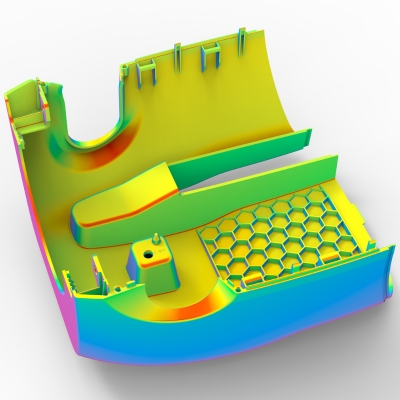
Internal corners, deep pockets, undercuts and more. A plain-English guide to the design limitations of CNC machining and how to... Continue reading
- Home
- PSLA 3D Printing
PSLA 3D Printing
QUICK LINKS
Material datasheets
Process datasheets
Request a quote
Matrix
Fast, high-quality resin parts for prototyping and short production runs
PSLA (Projection Stereolithography) is a high-speed resin 3D printing process designed to deliver strong, detailed parts with excellent surface quality.
By combining projection-based light curing with advanced engineering materials, PSLA produces accurate components quickly and consistently. This makes it an ideal solution for functional prototypes, design validation parts, and short production runs.
Our PSLA capability helps engineers and product designers move quickly from concept to physical parts, without the delays or costs associated with traditional tooling.
Ideal for functional prototypes and short runs
PSLA sits comfortably between rapid prototyping and low-volume manufacturing.
It’s particularly well suited to projects where part quality, speed and repeatability are important.
Typical applications include:
- Functional prototypes
- Product development models
- Enclosures and housings
- Consumer product prototypes
- Automotive components
- Design verification parts
- Short production runs
Because parts can be produced quickly and consistently, PSLA is also useful for bridge manufacturing before injection moulding.
A faster approach to stereolithography
PSLA uses projected light to cure liquid resin layer by layer.
Unlike traditional SLA systems that trace each layer with a laser, PSLA cures an entire layer at once. This significantly improves production speed while maintaining the accuracy and smooth surface finish associated with stereolithography.
The result is a process that delivers:
- High dimensional accuracy
- Excellent surface quality
- Strong functional parts
- Faster production times
For product developers, this means prototypes that can be tested, evaluated and refined more quickly.
Materials
Our PSLA process uses Matrix PB10 (Figure 4 PRO-BLK 10) engineering resin.
This material produces strong black parts with a high-quality surface finish and reliable mechanical properties.
Matrix PB10 is well suited to functional prototyping and engineering applications where strength, stability and cosmetic appearance are important.
Key characteristics include:
- Strong and durable material properties
- Excellent surface finish
- Good dimensional stability
- Suitable for functional parts and assemblies
The material is ideal for producing components such as housings, brackets, connectors and other detailed engineering parts.
Download the material datasheet.
Our equipment
Our PSLA capability is powered by the 3D Systems PSLA 270, a projection stereolithography system designed for the rapid production of accurate resin parts with excellent surface quality. The machine offers a generous build volume of 242 x 265 x 300 mm, allowing a wide range of functional prototypes, housings and engineering components to be produced in a single build.
Ready to get started?
If you’re developing a new product or exploring different manufacturing options, our team can help you determine whether PSLA is the right process for your design.
Get in touch on 01763 249760 to discuss your project with our team, or to book a tour of our facilities.
Request a Quote
Please Note: requests for our 3-Day production speed must meet our 3-Day criteria. All final data for our 3-Day production speed is required by 4.30pm.
To request a quote for any of our other technologies/services, such as Vacuum Casting, Model Making and Laser Cutting, please complete this contact form.
PSLA 3D Printing FAQ
What is PSLA 3D printing?
PSLA (Projection Stereolithography) is a resin-based 3D printing process that uses projected light to cure entire layers of material at once. This makes it faster than traditional SLA while still delivering high accuracy, smooth surface finishes and detailed parts.
How does PSLA differ from SLA and DLP?
PSLA and DLP both cure full layers in a single exposure, making them faster than SLA, which uses a laser to trace each layer. PSLA is designed for larger, functional parts with consistent mechanical properties, while DLP is often used for smaller, highly detailed components. SLA remains a strong choice for fine detail and surface finish, but PSLA offers a balance of speed, accuracy and part strength.
What are the advantages of PSLA?
PSLA combines speed, accuracy and material performance, offering:
- High dimensional accuracy
- Excellent surface finish
- Strong, durable parts
- Faster production compared to traditional SLA
This makes it ideal for projects that need both quality and quick turnaround.
What are the common uses of PSLA 3D printing?
PSLA is well suited to functional prototypes, product development models, enclosures, housings and design verification parts. It is also used for short production runs and bridge manufacturing ahead of injection moulding.
Is PSLA suitable for functional parts?
Yes. PSLA produces strong, stable parts using engineering-grade resin, making it suitable for functional prototypes, assemblies and short-term end-use applications. It is particularly useful where both mechanical performance and surface finish are important.
What material do you use for PSLA?
We use Matrix PB10 (Figure 4 PRO-BLK 10), an engineering resin that produces strong black parts with excellent surface finish and dimensional stability. It is well suited to functional prototypes and detailed engineering components such as housings, brackets and connectors.
What are the design guidelines for PSLA?
PSLA is capable of producing detailed and accurate parts, but for best results we recommend:
- Minimum wall thickness of around 0.5 mm for small features and 1 mm for larger sections
- Avoiding overly thick solid areas where possible, as this can affect print stability
- Considering support structures, which are removed during post-processing
Our team can advise on design optimisation to ensure accuracy, strength and surface quality.
What finishing options are available for PSLA parts?
PSLA parts are produced with a smooth surface finish as standard. Additional finishing options such as sanding, painting and cosmetic detailing are available to meet specific aesthetic or functional requirements.
What size parts can you produce with PSLA?
Our PSLA 270 machine offers a build volume of 242 x 265 x 300 mm, allowing us to produce a wide range of functional prototypes, housings and engineering components in a single build.
Can PSLA be used for low-volume production?
Yes. PSLA is ideal for short production runs and bridge manufacturing. It allows you to produce consistent, high-quality parts quickly, without the need for tooling.
How does PSLA compare to injection moulding?
PSLA is a faster, more flexible option for prototyping and low-volume production, as it does not require tooling. Injection moulding is more cost-effective for higher volumes, but PSLA is often used beforehand to validate designs and produce parts for testing or early market use.
Is PSLA suitable for bridge manufacturing?
Yes. PSLA is well suited to bridge manufacturing, allowing you to produce functional parts while tooling for injection moulding is being developed. This helps reduce time to market and supports product validation.
Is confidentiality guaranteed?
Yes. We frequently work with clients on pre-market products and are happy to sign NDAs to protect your project.
Our latest news
A practical guide to CNC prototyping for engineers. Discover the advantages over 3D printing, how a 3-day service accelerates development,... Continue reading

What is the difference between PSLA, SLA and DLP 3D printing? Learn how these resin printing technologies compare for prototyping... Continue reading
Prototype Projects introduces a new 200 x 100 x 90 mm CNC billet in aluminium and acetal, available for 3-Day... Continue reading
Compare stainless steel 304 and 316 for CNC machining. Understand corrosion resistance, machinability, cost and when upgrading to 316 makes... Continue reading
Compare Aluminium 6082 and 7075 for CNC machining. Understand strength, corrosion resistance, machinability and cost differences to select the right... Continue reading

Explore the design considerations for large-format SLA 3D printing, including wall thickness, orientation, internal features, and optical clarity. Continue reading

Learn what ±0.1 mm really means in CNC machining, how tolerances affect cost and manufacturability, and when tighter dimensions are... Continue reading

Celebrating 45 years of Prototype Projects, marking key milestones including Matrix, new SLA investment and the return of injection moulding. Continue reading
CNC Machining team
Our CNC machining team produce accurate, high quality parts with an excellent finish from our suite of CNC machines. Request a quote for your next prototype part.

Ian Reinemann
Senior CNC Manager

Dan Summerfield
CNC Programmer

Glenn Watts
CNC Operator / Setter

Carl Sheppard
CNC Programmer/Setter/Operator

James Llewellyn
Trainee CNC Operator Setter