- Home
- SLA Prototyping
- Hi Res or Not Hi Res? Is That the Question?
Hi Res or Not Hi Res? Is That the Question?
Here at Prototype Projects we’re regularly asked, by all types of clients, questions like: “Should I go with normal resolution for my 3D printing job – or do I need hi res 3D printing?”
It’s a topic we’ve debated many times over the years among ourselves, at tradeshows, with clients and with our industry peers.
The same questions tend to come to the surface fairly regularly:
- Is ‘high res’ better?
- When should I ask for high res?
- Why do you offer standard and high res?
- What are the benefits of high res?
- Why is high res more expensive?
The answer to all of them is the same: “Your need for high resolution or standard resolution for your 3D printing service depends on the geometry and required properties of your part”.
In this article, we look at some of the myths and realities about 3D Printing part resolution.
Let’s Start At The Beginning: What Does ‘Resolution’ Actually Mean?
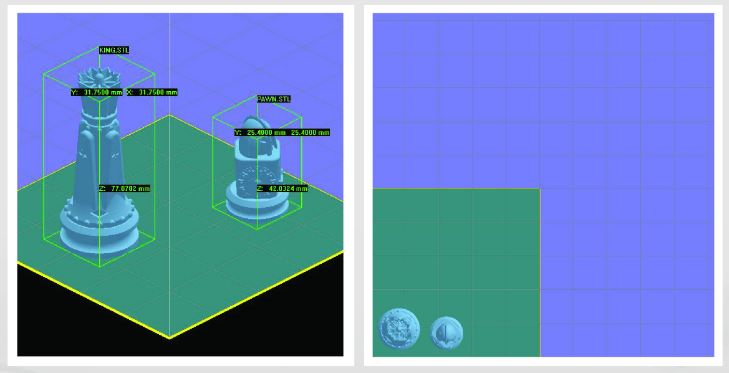
Resolution is a term that refers to a build style, of which there are two different types:
Standard Resolution Build Style:
- Layer thickness 0.1mm
- Laser Beam Diameter: 0.250 +- 0.025
- Build Platform: 250 x 250 x 250 mm
High Resolution Build Style:
- Layer thickness 0.05mm
- Laser Beam Diameter: 0.075 +-
- Build Platform: 125 x 125 x 250 mm
A common misconception is that the 0.1 (standard resolution) and 0.05mm (high resolution) build styles relate to the tolerance or accuracy of the printed part.
This is not the case.
Accuracy is dependent on:
- Part size and geometry
- Build orientation
- The purpose of the part (which in turn may dictate surface finish requirements)
Another popular misconception is that ‘high resolution is the same as high quality’.
Again, this is not the case because quality means many things to many people, including surface finish, which is, in general not impacted by high resolution or standard resolution build style.
As prototyping engineers and designers, we are concerned with accuracy (comprised of the factors above) – thus relegating “resolution” to a mere function of the overall requirement.

The High Resolution vs Standard Resolution Question Gets Even Harder To Answer
The Projet 6000 SLA machine (which superseded the Viper system in 2011) in the Prototype Projects 3D printing suite still prints in 2 build styles, 0.1mm and 0.05mm layers.
However, unlike the Viper, the Projet laser uses a dual spot function; small spot for borders and small features (determined by the software) and large spot for the infill or hatching areas.
This feature is applied to both build styles, so the need for 0.05mm layers really does now become more of a difficult question to answer.
In other words, as the Projet range of SLA machines gradually replaces the Vipers, the high resolution vs normal resolution question becomes more and more irrelevant.
Big Decisions For Prototyping Bureaus
So the Projet range of 3D printers is designed to replace the Viper SLA machines – which for many years were widely seen as the SLA machines of choice within the 3D printing industry.
The quality of the Viper systems is such that they are still very much core to many bureau operations today, even though they ceased to be made in 2011.
Yet the advent of the Projet range means the Viper SLA will be all but obsolete within a couple of years. The increasing difficulties associated with sourcing spare parts also indicates that the end of support services for these machines is also on the horizon.
The obvious implication is that with supplier plans to discontinue support and service for the Viper SLA machine, prototyping bureaus have got some big investment decisions to make if they want to continue offering the latest 3D Printing technologies.
Using Your Prototyping Bureau To Best Effect
Prototype Projects sees SLA as the ‘gold standard’ among 3D printing technologies, albeit that others are nipping at its heels.
Of course, most importantly though, the 3D printing technology selected should be appropriate to the job and results required by the client.
Since, in the vast majority of cases, design engineers cannot be expected to carry detailed knowledge of prototyping technology, they should make best use of prototyping engineers and bureaus who can offer the right advice on 3D printing technology and materials selection for their parts.
At the same time, designers’ requirements may be very specific. Surface finish quality, feature detail and mechanical properties will vary according to whether the part is required for visualisation, testing, form and fit or production purposes.
All of which means added choice – and complexity.
High Resolution SLA Not Always The Best Choice
Design engineers wanting the best 3D printing results, and who don’t have access to in-house 3D printing services, should ask their professional prototyping bureaus for advice on the choice of high resolution or standard resolution SLA.
High resolution SLA is not necessarily always the best choice for certain specific part geometries, or for producing parts for many types of intended use.
In fact, in some cases, high resolution SLA will actually deliver a worse quality product.
Any good prototyping bureau will make an assessment on required resolution based on their experience and knowledge.
High resolution is great in certain instances, but on most Viper SLA machines, however high SLA resolution can take more than twice the build time, meaning the cost is necessarily going to be higher.
There is no hard or fast rule that says “high resolution SLA is the best” – and while some prototyping bureaus claim to deliver high resolution parts as standard, there’s simply no point, and in some cases it may actually result in a substandard part.
To claim otherwise is not true.
To Summarise: The Prototype Projects Position on SLA Part Resolution
The position of Prototype Projects is that the SLA part resolution you need depends on:
- The geometry of your part
- The purpose of the part
- The properties you require
- Understanding the technology and applying it appropriately
If we can save you money by printing in standard resolution when you ask for high resolution, because the resulting part will be of the same or better quality, we’ll tell you.
We have the expertise, skills and experience to be able to advise on this because we have been doing this kind of work for over 35 years.
We believe our strength is that we have got a range of technologies to use and the depth of skills and expertise to help our clients use them properly.
Our promise to our clients is that they will always get honest advice about the most cost-effective options.
When it comes to small, detailed parts, we believe we are offering the highest quality prototyping service.
Interested in finding out more about 3D Printing or need to order a quote?
Request a quote on our website or call us on 01763 249760. Or if you would like to arrange a visit to our 3D Printing facilities in Royston, contact Prototype Projects.
PSLA vs SLA vs DLP | Resin ...
18 March 2026 Comments Off on PSLA vs SLA vs DLP | Resin 3D Printing Comparison
New Larger CNC Billet Expands 3-Day and ...
10 March 2026 Comments Off on New Larger CNC Billet Expands 3-Day and Production Capacity
Stainless Steel 304 vs 316 for CNC ...
5 March 2026 Comments Off on Stainless Steel 304 vs 316 for CNC Machining: When Does the Upgrade Make Sense?
Aluminium 6082 vs 7075 for CNC Machining
3 March 2026 Comments Off on Aluminium 6082 vs 7075 for CNC Machining
Large-Format SLA 3D Printing: Design Considerations
24 February 2026 Comments Off on Large-Format SLA 3D Printing: Design Considerations

Understanding the Difference Between CNC Milling and ...
15 April 2025 Comments Off on Understanding the Difference Between CNC Milling and CNC Turning for Better Design Choices